Sunday, January 6, 2013

Tablet sales seen doubling


Sales of tablet computers in India are expected to at least double this year to 6 million, the market’s third year of growth, as new devices attract business users and low costs draw consumers, research firm CyberMedia forecast.
Sales are likely to have reached 3 million in 2012, up from about 0.5 million in 2011, the firm estimated on Friday, citing data for the quarter to end-September, when companies led by Samsung Electronics Co Ltdsold 1.1 million tablets.
With the launch of low-cost devices running on Google Inc’s Android platform by local firms, sales of tablets and smartphones have grown rapidly in the last two years. A slew of global makers of tablets have also entered the market.
In 2013, new tablets based on Microsoft Corp’s Windows 8 platform and companies’ adoption of tablets for business applications will change the market significantly again, Faisal Kawoosa, lead analyst at CyberMedia’s telecom practice, said in a statement.
India is the world’s second biggest telecommunications market with about 900 million mobile phone accounts. But computer penetration is low, and only about a tenth of its 1.2 billion people have access to Internet.
Samsung had a 23.9% share of tablet computers sold in India in the July-September quarter last year, CyberMedia Research said.
Local firm Micromax ranked second with 15.3% of the market, while Datawind, the maker of Aakash tablet, billed as the world’s cheapest tablet computer, ranked third, it said in the report.
Apple Inc, the maker of iPad tablet computers, was ranked fifth with an 8.7% share, the data showed.
The average sales value of tablets during the quarter was about `13,200, while 63.5% of the sales were below `10,000, CyberMedia Research said.

Mittal pays full property tax in UK not availing discounts


Britain's richest man L N Mittal is among the few billionaires based here not to seek benefits on his property tax for his palatial house even as wealthy homeowners like the Sultan of Brunei avail discounts on their tax bills.
The 62 year-old NRI steel magnate, with a personal wealth estimated at around 12.7 billion pounds, stood out from a list of other residents of the posh Kensington Palace Gardens in the heart of London by paying the council tax on his property in full.
According to The Sunday Times, many of his neighbours are avoiding complete payment by using discounts on their council tax bills.
Some of the world's richest, who are least likely to need help with their bills, are receiving council tax discounts of 216 pounds on properties worth tens of millions of pounds.
Mittal had acquired the property in what is dubbed as billionaires' row from Formula One boss Bernie Ecclestone for 57-million pounds back in 2004, when it was believed to be the most expensive home in Britain.
The house is known for its extravagance with 12 bedrooms, an indoor pool, Turkish baths and parking for 20 cars.
The newspaper report claims that one in five such homes on the street qualified for a tax discount last year as "second homes" or long-term empty properties.
Figures show that the Sultan of Brunei enjoyed a second home discount of 10 per cent on his mansion in 2012, reducing his annual bill from 2,158 pounds to 1,942 pounds.
The Saudi royal family's home, opposite the Sultan's house on the same street, was among those which received a similar discount.
The revelation that some of the UK's richest homeowners qualify for council tax discounts will add to growing calls for the system to be overhauled, especially in view of the harsh economic conditions faced by the country.
From April, councils in Britain will have the power to remove the discount, which ranged between 10 and 50 per cent depending on the local authority.
The expected savings will go towards helping those on low income with their council tax bills.

South Sudan holds journalists for failing to cover president speech


Journalists often complain of persecution by the security services of the African republic that seceded from Sudan in 2011. That year, Juba authorities closed a newspaper after it criticized Kiir for allowing his daughter to marry a foreigner.
The government of South Sudan's Western Bahr El Ghazal state said it had detained two senior staff at its broadcaster for "administrative issues" after the station failed to cover Kiir's visit to the town of Wau last month.
"They were arrested simply because when the president arrived here in Wau on December 22, 2012, he gave a very, very important speech," state information minister Derrick Alfred Uya told Reuters.
The Committee to Protect Journalists, a New York-based media watchdog, named the detained pair as Louis Pasquale, director-general of the state broadcaster in Western Bahr el Ghazal, and Ashab Khamis, director of state television.
The committee said the two had been arrested probably as part of acampaign to stop the media from investigating recent unrest in Wau. Soldiers shot dead 10 people protesting against the relocation of a local council last month, triggering more violence in the town located close to the Sudan border.
"We call on authorities to release Louis Pasquale and Ashab Khamis immediately, and allow journalists to cover events in the state without facing intimidation or arrest," CPJ East Africa Consultant Tom Rhodes said in a statement.
A local journalist said security agents had been pressuring reporters in Wau to find out who had provided foreign news channels such as Qatar's Jazeera English with a tape which purportedly shows the shooting of unarmed protesters in Wau.
"I heard they arrested the journalists because they suspect the tape comes from state television," said the reporter, asking not to be named. "They were worried when the tape was shown on Jazeera."
South Sudan is a country with no media law, making it difficult for reporters to get information as the government and security services are mainly made up of ex-guerrillas who are used to impunity, a legacy of decades of civil war with Sudan.
Last month, unknown gunmen shot dead prominent blogger and government critic Diing Chan Awuol at his home.
France-based Reporters Without Borders ranked South Sudan 111th out of 179th in its 2011-2012 press freedom index.

Egypt's 10 minister cabinet reshuffle meets with opposition dissatisfaction


Egypt's controversial cabinet reshuffle that includes 10 new ministers was met by general dissatisfaction of the opposition forces, particularly the main opposition bloc dubbed "the National Salvation Front."
The opposition argues that the cabinet reshuffle does not provide any new vision to face the country's ongoing political and economic challenges, claiming that it is just meant to enhance the Muslim Brotherhood (MB)'s power in the government.
At least three out of the ten new ministers belong to President Mohamed Morsi's MB group, namely Supplies Minister Basem Kamal, Transportation Minister Hatem Abdel-Latif and Local Development Minister Mohamed Ali Bishr, increasing the total number of MB- originated ministers in the 35-minister cabinet to eight.
While it is uncertain whether or not the new Electricity Minister Ahmed Imam is a MB member, the new Finance Minister Al- Morsi al-Sayed Hegazi is known to be close to the group but not a member.
"The government is not the problem, but the lack of a specific strategy is the main problem," opposition Front member Wahid Abdel- Mageed told Xinhua, stressing that there should be a clear vision to deal with the economic and social crises, to resolve the issue of lack of security and to bridge the growing political gap.
"Political division will increase and the economic crisis will get worse if the Muslim Brotherhood and its political arm, the Freedom and Justice Party (FJP), remain stubborn and if the political leadership lacks the will and desire for consensus between all Egyptians for the common good," Abdel-Mageed added.
Further, Mohamed al-Saeed, general coordinator of Revolution Youth Union, said that rather than the reshuffle, the main problem was the government and its chief Prime Minister Hesham Qandil.
"The government's policies are wrong, and the recent cabinet reshuffle is only a plot by the Muslim Brotherhood to tighten their control of the country's joints and to dominate all ministries before the upcoming parliamentary elections," Al-Saeed said.
He noted that sacking former Interior Minister Ahmed Gamal Eddin was "a big political surprise" as security conditions started to gradually improve under his leadership.
Al-Saeed added that the ex-interior minister was neutral and fair in dealing with recent anti-government protests and therefore the MB wanted to have him sacked before the nationwide anti-Morsi protests intended on Jan. 25.
Political analysts believe that the MB was trying to dominate the short-term cabinet ahead of the upcoming parliamentary elections to guarantee their weight and strength in the Egyptian electoral street.
"The Muslim Brotherhood practices explicit interference that would confuse any minister," Ammar Ali Hassan, political analyst and researcher at Al-Ahram Center for Political and Strategic Studies, told Xinhua.
"Ministers understand that the Brotherhood, having an eye on the parliamentary elections, would not allow any official to make a decision that would negatively affect their status in the street, even if it's for the common good," he noted.
Hassan, therefore, believes that the new ministers will not be able to make any difference, pointing out that "the constitutional declaration according to which the government is formed make the ministers mere secretaries for the president who only carry out his commands."
For his part, political science professor Hassan Nafaa told Xinhua that "the Muslim Brotherhood group wants to rule the country in its own way, unaware that there is a deep political crisis that needs a completely different vision."
"I do not expect the new cabinet reshuffle to contribute to resolving the ongoing crises or to change things in the country even for a little bit," Nafaa added.
On the other hand, Morsi's main supporters, particularly the MB, welcomed the reshuffle and showed optimism about the move, which is a general Islamist reaction to the decisions made by Morsi or his government.
"We wish the best for the new ministers to achieve what their predecessors failed to do," MB spokesman Mahmoud Ghuzlan told Xinhua, adding that those criticizing the reshuffle were like evaluating a student without exams.
"Nothing will make them satisfied anyway," Ghuzlan noted, referring to the opposition that described the cabinet reshuffle as "inadequate."
Meanwhile, the MB's FJP's party spokesman Ahmed Sobea hoped that the cabinet reshuffle would make "a leap" in dealing with the ongoing challenges, inviting all political parties and forces to cooperate with the government, which does not represent a certain faction or political current according to Sobea.
"We call on everyone, supporters and opponents, to cooperate with the government. We as FJP offer all our expertise, cadres and qualified members to assist the government whenever required," Sobea told Xinhua.
As usual, Egypt's opposition and Islamists are poles apart, and the recent cabinet reshuffle seems to be nothing but a new dimension in the division between supporters and opponents of Morsi and his government.

Syrian opposition rejects Bashar al Assad's offer of national dialogue


Bashar al-Assad
Syria's opposition and its international backers have rejected Bashar al-Assad's latest initiative to end violence, insisting that he offered no meaningful concessions after 21 months of bloodshed and must surrender power at once.
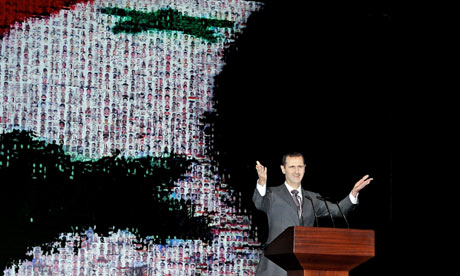
Hopes for a breakthrough in the crisis were dashed after an hour-long speech in Damascus in which the Syrian president called for "a war to defend the nation" against "terrorist" violence and urged foreign countries to stop supporting his enemies – while offering a national dialogue and a constitutional referendum.
Assad proposed what he called a "comprehensive plan" that included an "expanded government". But there was no sign he was prepared to step down as the first stage of a political transition – a demand of all opposition groups. "I will go one day, but the country remains," he pledged.
The Syrian leader referred repeatedly to "plots" against his country and the role of al-Qaida, long portrayed as the leading element in what began as a popular uprising in March 2011. Syria was not facing a revolution but a "gang of criminals" and "western puppets", he said.
"We are now in a state of war in every sense of the word," the president told cheering supporters. "This war targets Syria using a handful of Syrians and many foreigners. Thus, this is a war to defend the nation."
The speech from the stage of the Damascus Opera House in the heart of the capital was punctuated by thunderous applause and loyalist chants from what was certainly a carefully selected audience. The city was described as being under a security lock down before the event. Internet services were disconnected.
But it was hard to see how his latest address – the first in seven months – offered even a faint glimmer of hope of way out of the bloody impasse between the regime and rebels in a conflict which the UN said last week had claimed 60,000 lives.
The opposition Syrian National Coalition said the closely watched address marked an end to diplomatic efforts led by the UN mediator Lakhdar Brahimi. "The appropriate response is to continue to resist this unacceptable regime and for the Free Syrian Army to continue its work in liberating Syria until every inch of land is free," said George Sabra, its deputy president.
"It was a waste of time. He said nothing constructive," a spokesman, Louay Safi, told al-Jazeera TV. "It was empty rhetoric."
Walid al-Bunni, a veteran activist, said: "The genuine opposition inside and outside Syria won't accept the initiative."
Assad's speech was "beyond hypocritical", Britain's foreign secretary, William Hague, commented on Twitter. "Deaths, violence and oppression engulfing Syria are his own making, empty promises of reform fool no one." Earlier David Cameron repeated the call for Assad to step down.
Egypt's president, Mohamed Morsi, told CNN that he supported calls for Assad to be tried for war crimes.
Assad's last public comments were in November, when he told Russian TV he would "live and die in Syria". His last public speech was in June 2012.
Opposition media described clashes taking place between government and rebel forces near the Yarmuk refugee camp as well as anti-Assad demonstrations in Qadam and Homs. In all 52 people were reported killed, according to the Syrian Observatory for Human Rights, a UK-based monitor.
Rami Khouri, a commentator for Lebanon's Daily Star, tweeted: "Assad speech appropriately made in Opera House. It was operatic in its other-worldly fantasy, unrelated to realities outside the building."
Reconciliation could take place only with those "who have not betrayed Syria", the president declared, repeating that the government had no "partner" for peace. There could not be simply a political solution he insisted, but there had to be an end to violence and terror. There was loud cheering when he praised the bravery of the Syrian armed forces.
Assad said that a "national dialogue" would draw up a new charter that would be put to a national referendum that would be followed in turn by parliamentary elections and a general amnesty.
But Turkey's foreign minister, Ahmet Davutoglu, thought Assad had simply repeated empty promises. "As Assad no longer has the representative authority over the Syrian people, his words have lost persuasiveness," he said. "A transition period needs to be completed swiftly through talks with representatives of the Syrian nation."
In Brussels the EU foreign affairs chief, Cathy Ashton, promised to "look carefully" at the speech, but added: "We maintain our position that Assad has to step aside and allow for a political transition."
Opposition reactions were scathing. Colonel Riad al-Asaad of the FSA commented: "Assad speech business as usual. Death, destruction, starvation, detention, rape, torture, displacement … struggling to find the positive bits."
Another opposition supporter tweeted: "There is a saying in Arabic that goes along the lines of 'he killed the man then walked in his funeral procession.'" A video clip of the event posted by opposition media dubbed the soundtrack of the speech so that Assad barked liked a dog and the audience bleated and brayed like farmyard animals.
In his speech, Assad thanked Russia, China and Iran for supporting Syria in the face of hostility from the US, Britain and France. "Syria is impervious to collapse and the Syrian people impervious to humiliation," he concluded. "We will always be like that. Hand in hand we will move ahead, taking Syria to a brighter and stronger future."