Sunday, January 6, 2013

Syrian opposition rejects Bashar al Assad's offer of national dialogue


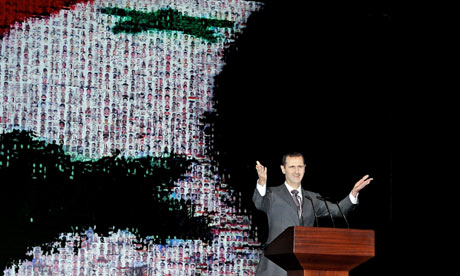
Bashar al-Assad
Syria's opposition and its international backers have rejected Bashar al-Assad's latest initiative to end violence, insisting that he offered no meaningful concessions after 21 months of bloodshed and must surrender power at once.
Hopes for a breakthrough in the crisis were dashed after an hour-long speech in Damascus in which the Syrian president called for "a war to defend the nation" against "terrorist" violence and urged foreign countries to stop supporting his enemies – while offering a national dialogue and a constitutional referendum.
Assad proposed what he called a "comprehensive plan" that included an "expanded government". But there was no sign he was prepared to step down as the first stage of a political transition – a demand of all opposition groups. "I will go one day, but the country remains," he pledged.
The Syrian leader referred repeatedly to "plots" against his country and the role of al-Qaida, long portrayed as the leading element in what began as a popular uprising in March 2011. Syria was not facing a revolution but a "gang of criminals" and "western puppets", he said.
"We are now in a state of war in every sense of the word," the president told cheering supporters. "This war targets Syria using a handful of Syrians and many foreigners. Thus, this is a war to defend the nation."
The speech from the stage of the Damascus Opera House in the heart of the capital was punctuated by thunderous applause and loyalist chants from what was certainly a carefully selected audience. The city was described as being under a security lock down before the event. Internet services were disconnected.
But it was hard to see how his latest address – the first in seven months – offered even a faint glimmer of hope of way out of the bloody impasse between the regime and rebels in a conflict which the UN said last week had claimed 60,000 lives.
The opposition Syrian National Coalition said the closely watched address marked an end to diplomatic efforts led by the UN mediator Lakhdar Brahimi. "The appropriate response is to continue to resist this unacceptable regime and for the Free Syrian Army to continue its work in liberating Syria until every inch of land is free," said George Sabra, its deputy president.
"It was a waste of time. He said nothing constructive," a spokesman, Louay Safi, told al-Jazeera TV. "It was empty rhetoric."
Walid al-Bunni, a veteran activist, said: "The genuine opposition inside and outside Syria won't accept the initiative."
Assad's speech was "beyond hypocritical", Britain's foreign secretary, William Hague, commented on Twitter. "Deaths, violence and oppression engulfing Syria are his own making, empty promises of reform fool no one." Earlier David Cameron repeated the call for Assad to step down.
Egypt's president, Mohamed Morsi, told CNN that he supported calls for Assad to be tried for war crimes.
Assad's last public comments were in November, when he told Russian TV he would "live and die in Syria". His last public speech was in June 2012.
Opposition media described clashes taking place between government and rebel forces near the Yarmuk refugee camp as well as anti-Assad demonstrations in Qadam and Homs. In all 52 people were reported killed, according to the Syrian Observatory for Human Rights, a UK-based monitor.
Rami Khouri, a commentator for Lebanon's Daily Star, tweeted: "Assad speech appropriately made in Opera House. It was operatic in its other-worldly fantasy, unrelated to realities outside the building."
Reconciliation could take place only with those "who have not betrayed Syria", the president declared, repeating that the government had no "partner" for peace. There could not be simply a political solution he insisted, but there had to be an end to violence and terror. There was loud cheering when he praised the bravery of the Syrian armed forces.
Assad said that a "national dialogue" would draw up a new charter that would be put to a national referendum that would be followed in turn by parliamentary elections and a general amnesty.
But Turkey's foreign minister, Ahmet Davutoglu, thought Assad had simply repeated empty promises. "As Assad no longer has the representative authority over the Syrian people, his words have lost persuasiveness," he said. "A transition period needs to be completed swiftly through talks with representatives of the Syrian nation."
In Brussels the EU foreign affairs chief, Cathy Ashton, promised to "look carefully" at the speech, but added: "We maintain our position that Assad has to step aside and allow for a political transition."
Opposition reactions were scathing. Colonel Riad al-Asaad of the FSA commented: "Assad speech business as usual. Death, destruction, starvation, detention, rape, torture, displacement … struggling to find the positive bits."
Another opposition supporter tweeted: "There is a saying in Arabic that goes along the lines of 'he killed the man then walked in his funeral procession.'" A video clip of the event posted by opposition media dubbed the soundtrack of the speech so that Assad barked liked a dog and the audience bleated and brayed like farmyard animals.
In his speech, Assad thanked Russia, China and Iran for supporting Syria in the face of hostility from the US, Britain and France. "Syria is impervious to collapse and the Syrian people impervious to humiliation," he concluded. "We will always be like that. Hand in hand we will move ahead, taking Syria to a brighter and stronger future."

Delhi gang rape Victim's father wants world to know her real name


A traumatised father of the 23-year- old Delhi gang-rape victim wants the world to know his daughter's real name to give courage to other victims while demanding death for all the six accused "beasts".
Following the girl's brutal assault in a moving bus in Delhi on December 16, the Indian media has refrained from naming her.
She died on December 29 at a Singapore hospital where she was shifted to from Delhi's Safdarjung Hospital in an extremely critical condition.
"We want the world to know her real name. My daughter didn't do anything wrong, she died while protecting herself. I am proud of her. Revealing her name will give courage to other women who have survived these attacks. They will find strength from my daughter," the victim's 53-year-old father told The Sunday People, the Daily Mirror's Sunday edition, in his ancestral village in Ballia in Uttar Pradesh.
His comments sparked off a debate on the social media. Naming her would give a face to the movement seeking strict laws for crimes against women, a Facebook post said.
Another said, the victim already has several pseudonyms given by the media and the people will fight back.
The newspaper posted the father's picture with his name. It then revealed the victim's name, saying it had the permission of the father.
The father showed the family album with photographs of his daughter smiling. While in some photographs she was wearing traditional saree, in others, she was mostly in western clothes.
The newspaper said in deference to the father's wish not to make public her picture, it was not doing so.
Indian law forbids revealing of the name of a rape victim unless her family agrees to it.
Since her death, the girl's family has retreated to their village.
"At first I wanted to see the men responsible face to face but I don't want to any more. I just want to hear that the courts have punished them and they will be hanged," the newspaper quoted the father as saying.
"Death for all six of them. These men are beasts. They should be made an example of and that society will not allow such things to happen," the girl's father said.
The girl's father told the newspaper that the friend of the victim was not her boyfriend, just a very brave friend who tried to save her.
"There was no question of her marrying because we belong to different castes. She never expressed a desire to marry. She was concentrating on her studies and wanted a job first," he said.
The father also revealed that the girl often mentioned how much her friend tried to save her.
"She kept telling her mother he tried his best to help but they kept beating him with a rod," the father said.

Friday, January 4, 2013

Samsung India officially launches Galaxy Music Duos


Samsung seems to have silently launched Galaxy Music Duos smartphone in the Indian market. The company had unveiled it internationally in October 2012 and begun taking pre-orders in India in the first week of December. The official cost of the device in India is Rs 9,199, though the street price is Rs 8,990. 
The all-new Galaxy Music Duos is a dual-sim smartphone aimed at music lovers and comes with two speakers in the front, a dedicated music key and audio technologies like Sound Alive and SRS. This device has a 3-inch LCD touchscreen with 240x320-pixel resolution and runs on an 850MHz processor with 512MB RAM. It has 4GB internal memory and supports 32GB microSD cards for expansion.

Powered by a 1,300mAh battery, the device comes with a 3MP camera without flash and also misses a front-facing snapper. For connectivity, Samsung Galaxy Music Duos has features like Wi-Fi, 3G, 2G, Bluetooth 3.0 and microUSB.

Galaxy Music Duos features Always On technology, which allows users to take calls on one sim, while keeping calls on the other sim on waiting.

Key specs of Samsung Galaxy Music Duos:

Display: 3-inch LCD touchscreen with 240x320-pixel resolution;
Operating system: Android 4.0 (Ice Cream Sandwich);
Processor: 850MHz;
RAM: 512MB;
Memory: 4GB internal, support for 32GB microSD card;
Camera: 3MP rear camera;
Connectivity: Wi-Fi, 3G, 2G, Bluetooth 3.0 and microUSB;
Battery: 1,300mAh;
Misc: Dedicated music key, Sound Alive and SRS audio technologies, dual frontal speakers, Always On

Acer to launch 7-inch Android 4.1 tablet at Rs 7999 in India

The competition in the budget tablet market seems to be getting hotter. Acer is reportedly all set to launch its upcoming Iconia Tab B1 for Rs 7,999 in India. The tablet is speculated to be rolled out in early 2013. 

Previously, Wall Street Journal quoted a source as saying that Acer was working on a $99 tablet that will have a 7-inch screen with 1024x600presolution and run on Android 4.1 (Jelly Bean). A US Federal Communications Commission(FCC) application for the tablet revealed others specifications of the Google Nexus 7 rival, including 1.2GHz dual-core processor, 512MB RAM, 8GB onboard storage, Bluetooth 4.0, Wi-Fi as well as microSD support. 

Though it made an appearance at US FCC, the tablet according to WSJ, is aimed primarily at emerging markets. Images of Acer Iconia Tab B1 surfaced on a Serbian forum and were confirmed to be real by WSJ's source. 

Earlier in November, Asus-manufactured Google Nexus 7 was launched at Rs 19,999 in India, much higher than expected, considering that the device sells for $199 in US. According to a CyberMedia research, Micromax was the leader in the Indian tablet market in second quarter of 2012. In October last year, Manufacturers Association of IT predicts that the country's tablet market is set to grow by 40% till 2015-16, to 7.3 million units from 0.95 million units in 2012. 


Acer Iconia B1 Specifications
  • Display screen size 7.0 inches LCD capacitive touchscreen
  • Display resolutions are 1024 x 768
  • Acer Iconia B1 is provided with a 1.2 GHz dual core processor
  • It runs on Android V4.1 Jelly Bean operating system
  • Internal memory is 8GB
  • Expandable memory up to 32 GB
  • RAM provided is 512 MB
  • Audio player AAC, FLAC, MP#, WMA, WAV and OGG
  • Video Player AVC MPEG-4, AVI j264

If Acer captures the attention of the Indian tablet buyers with its Iconia Tab B1, it is expected to give tough competition to Micromax's Funbook series, the leader in the tablet segment in India. It is widely expected that the Taiwanese manufacturer will showcase the device at Consumer Electronics Show, scheduled for Jan 8 to 11, 2013, in the US.

Mid-tier IT companies may give small increment in 2013


Faced with continuing uncertainty in their largest markets, US and Europe, mid-sized technology outsourcing companies will give out tepid pay hikes and cut down on their campus hiring in 2013.

Coming out of a slow year when the IT industry saw slowing revenue growth thanks to clients being more cautious about technology spending, software services exporters such as Infinite Technologies, Mastek, Mahindra Satyam andInfotech Enterprises said the pay hikes could be as low as 5% this year.

Compared to double-digit pay hikes till a few years ago, salary increments in India's $100-billion (Rs 5.5 lakh crore) IT industry has been consistently declining since the financial crisis of 2008, from which US and Europe is yet to completely recover. "Wage hikes for IT employees will be lower than last year due to slowdown in the US and European markets and pricing pressure from clients there," said BVR Mohan Reddy, chairman and managing director of Hyderabad-based Infotech Enterprises, which employs about 10,000 people.

It had given out average pay hike of 15% to its offshore employees and 3% to employees in onsite locations in US or Europe. "Hiring too will be lower compared to last year," Reddy said.

Indian IT companies typically give out salary increases during the first three months of the financial year that starts in April while campus job offers are made in November-December. IT firms hire close to 1.5 lakh students from campuses every year. But with large companies unable to predict near-term growth with any degree of certainty, industry watchers say they are doubtful about robust growth among larger IT companies, let alone tier-II firms.
"There are no signs of de-growth as of now, but companies have clearly become more selective about hiring," said Aditya Narayan Mishra, head of staffing business at human resources firm Randstad India.

Hyderabad-based Mahindra Satyam, for instance, said it plans to cut down on its campus hiring by 50% in the coming year due to the unpredictable business environment.

"You can be sure that it will be a muted year," said Hari Thalapalli, chief people officer at Mahindra Satyam, which gave 6.5% hike to offshore and 1.5% to onsite employees last year.

Thalapalli's concerns are echoed by other executives in the industry such as Farid Kazani, chief financial officer at Mumbai-based Mastek who said that as of now things look "quite muted."

"We don't expect a major increase (in pay hike) due to the on-going pressure in the IT sector," Kazani said. With large firms such as Infosys and Wipro offering meagre hikes and postponing hiring decisions, Kazani said mid-tier IT firms find it easier to retain employees. "There is no pressure to hire or offer wage hikes." Mastek said it will take a final call on pay hikes in a month's time.

Last year, the country's second-largest IT exporter Infosys had delayed joining dates of over 20,000 freshers and did not give pay hikes to its over 150,000 employees during the normal schedule, citing volatility in business environment. Its cross-town rival Wipro gave 8% average wage hike to its offshore and 3% to onsite staff. This year it will be below 10%," said Upinder Zutshi, chief executive officer at Infinite. "The coming year will be challenging.